

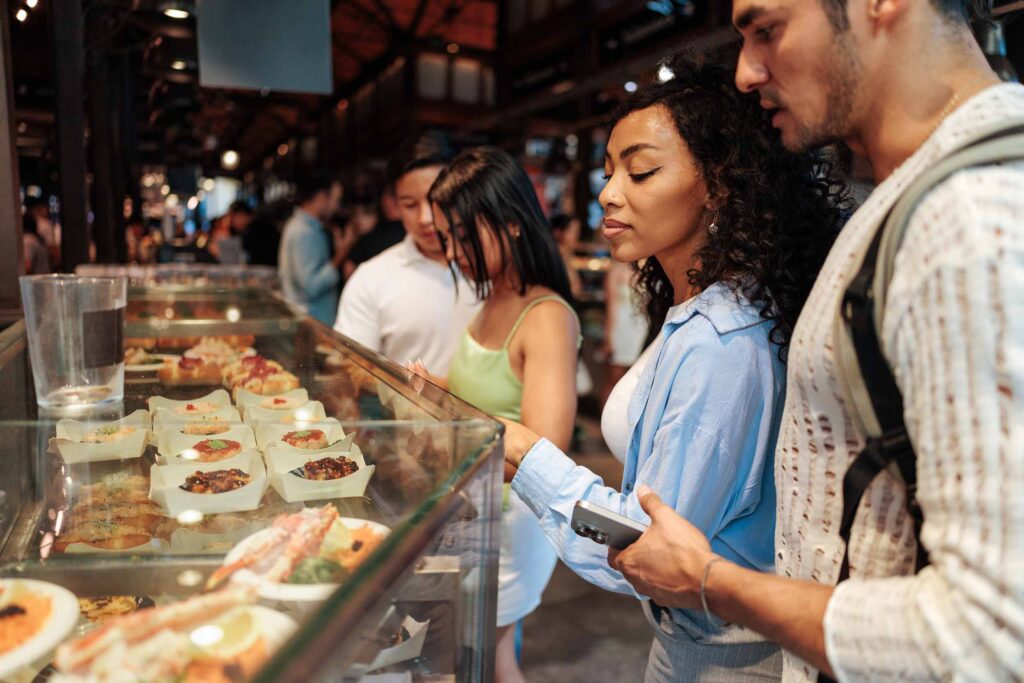
Barcelona has a very particular way of getting to you through your stomach. You do not need to book a table at the latest fashionable place or chase down impossible addresses to understand it: sometimes all it takes is stepping into a market, seeing what is on sale, listening to how people order and letting yourself drift for a while among the stalls, aromas and accents. That is where a more everyday, more flavourful and far more authentic city appears than the one in the tourist headlines.
That is why, if you want to discover Barcelona’s iconic markets from a more grounded and less obvious angle, it is worth looking beyond the quick snapshot of La Boqueria (though that still does not stop it being an essential stop). Some markets have spectacular architecture, others are perfect for an unhurried bite, and some also happen to be very close at hand if you are staying in the Eixample. This route brings together five stops that really are worth it: for the atmosphere, the produce and that very Barcelona blend of neighbourhood life and history.
And that is precisely what makes it interesting: it is not just about deciding where to eat, but choosing how you want to experience the city. You can drop into an iconic market first thing, head later to a quieter one, buy something delicious for an improvised simple supper and return to your room with the feeling that you have come to know a more intimate Barcelona. One that does not merely put itself on display, but also lets itself be tasted.
5 must-visit markets in Barcelona
1. La Boqueria
La Boqueria is the great classic. It sits right on La Rambla and has been part of Barcelona’s collective imagination for centuries. The current market opens Monday to Saturday, from 8.00 am to 8.30 pm, and remains one of the city’s best-known food spaces.
That said, this is one place where a slightly less naïve reading helps. Many people arrive expecting a purely local experience and instead find one of the most tourist-heavy spots in Barcelona. That does not make it any less worthwhile, but it does mean you need to visit with a bit of strategy. The best advice is simple: go early, avoid the middle of the day and do not stop at the entrance. The stalls further in usually feel calmer and, very often, more authentic.
What is more, La Boqueria works brilliantly as a first introduction. It has colour, movement, history and produce. If you fancy an informal bite, budget around €10 to €20 per person, depending on how much you want to try. It is not the cheapest market on this list, but it is one of the most recognisable.
2. Santa Caterina Market
Santa Caterina Market is in a different league. Here, the star is not just the produce: the building is part of the draw too. Its undulating multicoloured roof has made it one of the most recognisable images in contemporary Barcelona architecture, and for good reason. The market reopened in 2005 after a major refurbishment and is now one of those stops that combines the practical with the visually striking.
Compared with La Boqueria’s more intense pace, Santa Caterina is much easier to take in. There is less tourist pressure, it is easier to get around, and you can have a proper look without feeling as though you are edging forward in a crowd. For anyone who enjoys looking just as much as eating, it is an especially rewarding stop.
It has another advantage too: it fits neatly into a walk through the historic centre. You can link it with El Born, the cathedral area or even a morning of wandering with no fixed plan. In Barcelona, that usually turns out well.
3. Sant Antoni Market
Sant Antoni Market has a very distinct personality. It stands out not just for its food side, but for the cultural and everyday dimension that makes it different. Its defining feature is the Sant Antoni Sunday Market, open every Sunday of the year from 8.30 am to 2.00 pm, and long established as a small institution for anyone who enjoys hunting for books, magazines, trading cards, posters or collectible oddities.
It is an especially interesting stop for the kind of traveller who does not want to limit themselves to ‘seeing things’, but wants to get a feel for the city’s real life. There is something very Barcelona about that Sunday plan that mixes strolling, the market, vermouth and time to enjoy yourself without hurrying.
The building itself has plenty of appeal as well. The market’s historic structure has been preserved, and the area keeps that balance between a lived-in neighbourhood and a city open to visitors. It is not a place designed to please; it pleases because it is still authentic and real.
4. La Concepció Market
This is one of the strongest points on the route. La Concepció Market, right in the Eixample, is probably the most practical option if you are staying at Primavera Hostel. Its food market opens Monday to Saturday, and its florists operate 24 hours a day, Monday to Sunday, except in August. That quirk makes it one of the neighbourhood’s most distinctive stops.
But what makes it interesting is not just that it is close by. It has the soul of a neighbourhood market and, at the same time, a very particular charm. It does not try to dazzle visitors through spectacle. It works differently: you need to go in, look, buy, come back. It is a market to live with, not just photograph.
And this is where Primavera Hostel has a real advantage. Its location at Carrer de Mallorca 330, very close to Verdaguer and in a quiet residential area that is still extremely well connected, lets you use this market almost as though it were part of the everyday rhythm of the trip. You can pop down to buy something fresh, stroll back, and make use of the shared kitchen to put together a simple supper without much fuss. It is an easy way to sort out a meal, save a bit of money and, at the same time, stay connected to neighbourhood life. For anyone who prefers to travel at an unhurried pace and with a bit of freedom, these details make a real difference.
5. Llibertat Market
Whenever you feel like stepping a little away from the most central axis and breathing a different rhythm, Gràcia is usually a very good idea. And within Gràcia, the Llibertat Market is well worth your time. It opens Monday to Friday from 8.00 am to 8.30 pm, and on Saturdays until 3.00 pm. Its modernista building, its history and its commercial life make it one of the most pleasant stops for understanding another Barcelona, less immediate and more rooted in neighbourhood life.
What is good about this market is that it does not end with the market itself. You arrive for the market and end up staying for everything else: the squares, the narrow streets, the terraces, the independent shops with character. If you are after a foodie route with a bit more context and a bit less autopilot, this stop works especially well. It is not far from Primavera Hostel, either.
Eating cheaply in Barcelona’s markets without going for the obvious
Yes, you can eat cheaply in Barcelona’s markets, but this is where another small myth needs dismantling: not all markets are equally affordable, and not all are set up for you to sit down and sort out a full meal for very little money. The key is usually to combine them. One market to see, another to buy from, a third for a quick bite, and Primavera Hostel as a base for rounding off the plan in comfort.
That logic works especially well in spring, when it is more tempting to walk, stretch out the morning and return unhurriedly to the Eixample with a bag full of fresh produce, good bread, some fruit or a bunch of flowers from La Concepció Market to give the room a different feel. It may not sound like much of a plan on paper, but it ends up being exactly the kind of memory that stays with you.
A hostel in Barcelona city centre to discover the city from another angle
Not every place to stay lets you experience this route in quite the same way. Being in a well-connected spot changes a great deal. Primavera Hostel, in the Eixample, makes it easy to move between markets, neighbourhoods and landmarks, without giving up a calmer setting when you come back. In a city like Barcelona, that is something you really appreciate. The hostel also occupies a building with character, offers a warm, carefully considered experience, and has communal spaces and a shared kitchen that suit this more flexible, more local kind of break particularly well.
Book your stay and explore Barcelona’s markets at your own pace
If you fancy discovering Barcelona’s iconic markets without rushing the city, Primavera Hostel is a very good place to start. Its Eixample location, welcoming atmosphere and the option of cooking with fresh market produce make it easier to plan the trip with more freedom and make the most of everything the city has to offer.Book your roomat Primavera Hostel and discover Barcelona at its most flavourful, most everyday and most authentic.